|
W2i Digital Cities Convention to
launch in Philadelphia this May
For Immediate Release
Largest event in a global thought-leadership series to accelerate the adoption of broadband wireless technologies for economic and social development worldwide; hosted by the Wireless Internet Institute in partnership with private sector, local government and international development organizations
December 16, 2004 (Boston, Mass.)The emergence of broadband wireless metropolitan area networks is now a rapidly advancing, global municipal-technology trend of the early 21st century. When successfully deployed, the pervasive "ether" of these networks can provide high-speed connectivity to residents and bridge the digital divide, increase government-employee efficiency and provision of services to citizens such as public safety, and point to potential revenue-generation models through innovative public-private partnerships.
Simultaneously, these networks present a range of opportunities and risks as well as hopes and concerns for local-government leaders, technology providers, and incumbent telecoms, as well as regulatory considerations at the local, state and national levels. To provide stakeholders with high-level analysis, brainstorming sessions and an opportunity for consensus building on the issues surrounding municipal broadband wireless networks, the Wireless Internet Institute will launch the Digital Cities Convention in Philadelphia on May 2-4, 2005.
Philadelphia was chosen to launch the Convention in light of Wireless Philadelphia", an ambitious initiative to strengthen the city’s economy and transform its neighborhoods by providing wireless Internet access for the purpose of helping citizens, businesses, schools, community organizations and visitors make effective use of the wireless Internet. About 40% of Philadelphia’s population still has no access to broadband and won’t anytime soon because those neighborhoods are not attractive to present service operators given current wired-technology infrastructure costs.
At the end of November, Pennsylvania Governor Edward Rendell signed a wide-ranging telephone and broadband bill, supported heavily by incumbent service operators, that generally prohibits municipalities from providing Internet access to their residents for a fee. The Governor’s November 30th press release stated: "Municipalities that are providing telecommunications service through a municipally owned or created network as of January 1, 2006 can continue to offer and provide the services ‘to the extent and scope' that these services were provided before that date. After that window closes, municipalities must offer the incumbent telephone company the right of first refusal to provide the proposed service." In the case of Philadelphia Wireless, Verizon has agreed to waive its right of first refusal, "guaranteeing that the particular project can proceed," the governor stated.
The U.S. Supreme Court has upheld that municipalities cannot make their own telecommunications decisions if higher entities tell them not to. But with municipalities around Pennsylvania attempting to launch broadband wireless metropolitan area networks, what would compel a higher entity to stand in their way? The state clearly took into consideration the interests of incumbent service operators. But were Pennslyvanians, not least the underserved populations who live far from high-speed wire-line infrastructure, well served?
From Controversy to Consensus-Building
Through a two-year program of conferences and research efforts, the Wireless Internet Institute has identified the drivers spurring municipalities’ interest in broadband wireless networks. In short, local authorities seek:
• competitive communications infrastructures for all constituents;
• increased productivity for government workforces that can lower labor costs;
• free or reduced-cost connectivity for underserved populations in urban neighborhoods and outlying communities;
• information services and e-government solutions for all local constituents; and
• a technology-friendly or cutting-edge reputation for the municipality.
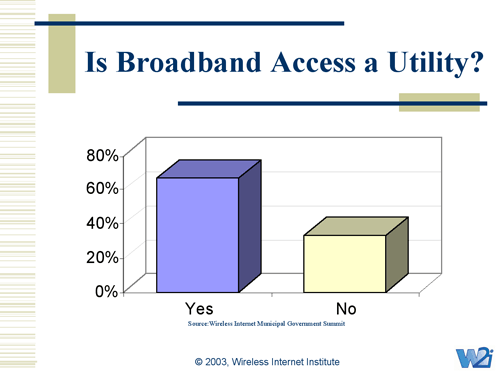
Because of these drivers, local authorities like those in Philadelphia and in municipalities around the world have begun taking an increasing leadership role in fostering the adoption and deployment of broadband wireless infrastructure, which W2i research shows is overwhelmingly perceived as an essential utility.
Consequently, a new ecosystem of technology providers, systems integrators, and service providers has begun taking shape along with the emerging support of development and infrastructure funding organizations. As an independent observer of these trends, the Wireless Internet Institute focused its activities on:
• fostering the adoption of favorable regulatory frameworks in compliance with the World Radio Conference resolution on unlicensed spectrum;
• exploring sustainable business models, including public-private partnerships;
• sharing of best practices among field practitioners; and
• disseminating information on broadband wireless technologies.
Private-Sector Endorsements
In addition to cooperation agreements with the UN ICT Task Force, the UN Insitute for Training and Research (UNITAR), and CIFAL Atlanta, the W2i Digital Cities Convention is endorsed by the WiMAX ForumTM and has secured the early sponsorship of global-technology leaders like Alvarion, Belair Networks, IBM, Redline Communications and SR Telecom.
"The nearly unanimous support for WiMAX technology among integrators and the continued interest from service providers demonstrates the potential for WiMAX to deliver on the global challenge of providing broadband on a ubiquitous scale," said Ron Resnick, president of the WiMAX Forum‰. "We welcome the initiative of the Wireless Internet Institute to explore the range of issues facing local authorities wishing to deploy this technology in municipal settings."
"Cities throughout the world, especially those in remote areas underserved by wireline infrastructure, can immediately benefit from broadband wireless networks," said Zvi Slonimsky, CEO of Alvarion. "The W2i Digital Cities Convention in Philadelphia will encourage thought leadership on integrated solutions as well as funding and implementation challenges for these networks."
We're delighted with the Wireless Internet Institute’s effort to bring together the full range of stakeholders to discuss the sustainable deployment of broadband wireless networks for municipalities," said Bernard Herscovich, President and CEO, BelAir Networks. "Creating networks of this scale requires the cooperation of private sector and government agencies."
"IBM is helping large and small service providers work together to manage complex "virtual" or shared networks ensuring that the processes for network and value-added service provisioning are kept simple for the user and for the overall operations management of the operator" said Scott Stainken, General Manager, Global Wireless Business, IBM Corporation "IBM’s support of W2i Digital Cities Convention inscribes itself in its continuing effort to lead service provider and public sector collaboration in advancing broadband capabilities, helping them leverage each other’s resources to deliver cost-effective, value-added services to customers and constituents, and achieve sustainable models for future growth."
"Our commitment is to grow the broadband fixed wireless industry and to help municipalities in their efforts to meet the needs of the constituents," said Majed Sifri, CEO, Redline Communications. "The W2i Digital Cities Convention is an opportunity to explore the many stakeholder opportunities and roadblocks in this growing market."
"Understanding and addressing the infrastructure needs of underserved communities with broadband fixed wireless solutions has long been a core competency of SR Telecom," said Pierre St Arnaud, President & CEO of SR Telecom. "W2i Digital Cities Convention greatly facilitates the sharing of best practices among local government stakeholders in the pursuit of universal access"
Convention Grounds
In addition to an exhibit hall showcasing state-of-the-art vendor solutions designed to address the needs of local governments and their constituencies, the W2i Digital Cities Convention program was developed in cooperation with an expert Program Committee chaired by Dianah Neff, Chief Information Officer, City of Philadelphia. The multi-track Convention gathers together a primary audience of local-government elected and agency officials as well as stakeholders in the emerging broadband wireless ecosystem of regulators, technology vendors and service providers, system integrators, real-estate and rights-of-way owners, and funding organizations.
"Philadelphia’s population has no access to nomadic broadband as local carriers only provide fixed wireless services" Neff said. "They also do not address the issue of affordability and overcoming the inner-city digital divide and they won’t anytime soon because those underserved neighborhoods are not attractive to present service operators given current wired-technology infrastructure costs."
"There is an opportunity in Philadelphia to have a dialogue among all stakeholders, to see how incumbent service operators should see this municipal desire to invest in infrastructure as a potential business enhancer, rather than a threat" said Costis Toregas, president emeritus of Public Technology, Inc. and a member of the program planning committee.
Over two and a half days, the Convention will feature plenary sessions, case studies and thought-leadership workshops fostering rich peer exchanges of ideas and knowledge sharing on the benefits and challenges of implementing broadband wireless infrastructure to improve municipal workforce productivity and services to the citizens, and to foster economic development and address the growing inner-city and rural digital divide.
A Global Program
The W2i Digital Cities Convention will be held annually in each of three regions of the world. In 2004, planning is in final stages for conventions in North America (this May in Philadelphia), Asia and Europe as part of W2i’s cooperation with its international-development institution partners.
"W2i initiatives have been designed with one of the leading development goals of our time in minduniversal connectivity," said Marcel Boisard, Executive Director, United Nations Institute for Training and Research, or UNITAR. "The Digital Cities Convention involves all key stakeholders, from local government to the private sector and field practitioners."
For more information on these programs or to partner with W2i, e-mail us at
About W2i
The Digital Cities Convention is the newest in a series of thought-leadership conferences undertaken in partnership with the United Nations ICT Task Force, the private sector, local authorities and regulators, and international development institutions. The purpose of W2i’s multi-year "Global Municipal Government and Local Authorities Series" is to foster the adoption of broadband wireless technologies under the leadership of local government organizations around the world, in support of universal connectivity, the Millennium Development Goals, and the Declaration of Principles of the World Summit for the Information Society in Geneva (2003) and Tunis (2005).
was launched in 2001 as an international, independent think tank bringing together broadband wireless stakeholders to accelerate the adoption of wireless Internet in support of universal connectivity for economic, social and educational development around the world. W2i, a division of , addresses policy, regulatory and economic models, and sharing of best-practice issues associated with the deployment of wireless Internet technologies.
|